Global Agro & Food Exhibition Calendar 2026–27
- Home
- Global Agro & Food Exhibition Calendar 2026–27
A Practical Guide for Indian Exporters Looking Beyond the Indian Market
Every exporter has a different story.
Some exporters have a good product but are struggling to find the right overseas buyer. Some already have buyers but want to enter new countries. Some are looking for distributors, some are looking for private-label opportunities, and some are simply trying to understand which international markets can actually accept their products.Over the years, one thing becomes very clear:
Finding an international buyer is not only about sending quotations. It is about being present where the right buyers are looking for products.
And this is where international exhibitions can become very useful.A good exhibition can put an Indian exporter in the same place as importers, distributors, wholesalers, retailers, food manufacturers, foodservice companies and sourcing professionals from different countries.But there is another side to exhibitions too.
Not every exhibition is suitable for every exporter.
That is why we wanted to prepare this Exhibition Calendar as a practical reference for Indian Agro & Food Exporters.
Why Are Exhibitions Important for Exporters?
Imagine an Indian exporter sitting in Coimbatore, Pollachi, Erode, Nashik, Pune, Delhi, Hyderabad or any other part of India.The exporter has a good product.
The product may be:
- Coconut.
- Rice.
- Garlic.
- Onion.
- Ginger.
- Spices.
- Pulses.
- Mango.
- Banana.
- Pomegranate.
- Vegetables.
- Processed food.
- Coconut derivatives.
- Or another value-added agricultural product.
The question is:
Who is going to buy it?
We can search on Google.
We can send emails.
We can use LinkedIn.
We can contact importers.
We can use B2B platforms.
We can approach distributors.
But sometimes, meeting the right person face-to-face can change the conversation completely.
An exhibition gives an exporter an opportunity to say:
“This is our product. This is where we source it. This is how we process and pack it. This is what we can supply. What are you looking for?”
That conversation can open another conversation.
And another.
Sometimes it may lead to a sample.Sometimes an RFQ.Sometimes a trial shipment.Sometimes nothing happens immediately.But the market knowledge gained can still be valuable.
One Important Lesson We Have Learned
Don’t select an exhibition simply because it is famous.Select it because your product and your target buyer are there.
For example, a fresh garlic exporter may get more relevant conversations at a fresh-produce exhibition than at a general food exhibition.
A rice exporter may look at food and commodity-focused events.A coconut ingredient supplier may look for food ingredient and food-processing buyers.An organic-certified exporter may consider organic-focused exhibitions.A value-added food manufacturer may look at food, retail, private-label and ingredient events.
So the process should ideally be:
Product → Market → Buyer → Exhibition → Meeting → Follow-up
Not:
Big Exhibition → Buy Booth → Hope for Orders
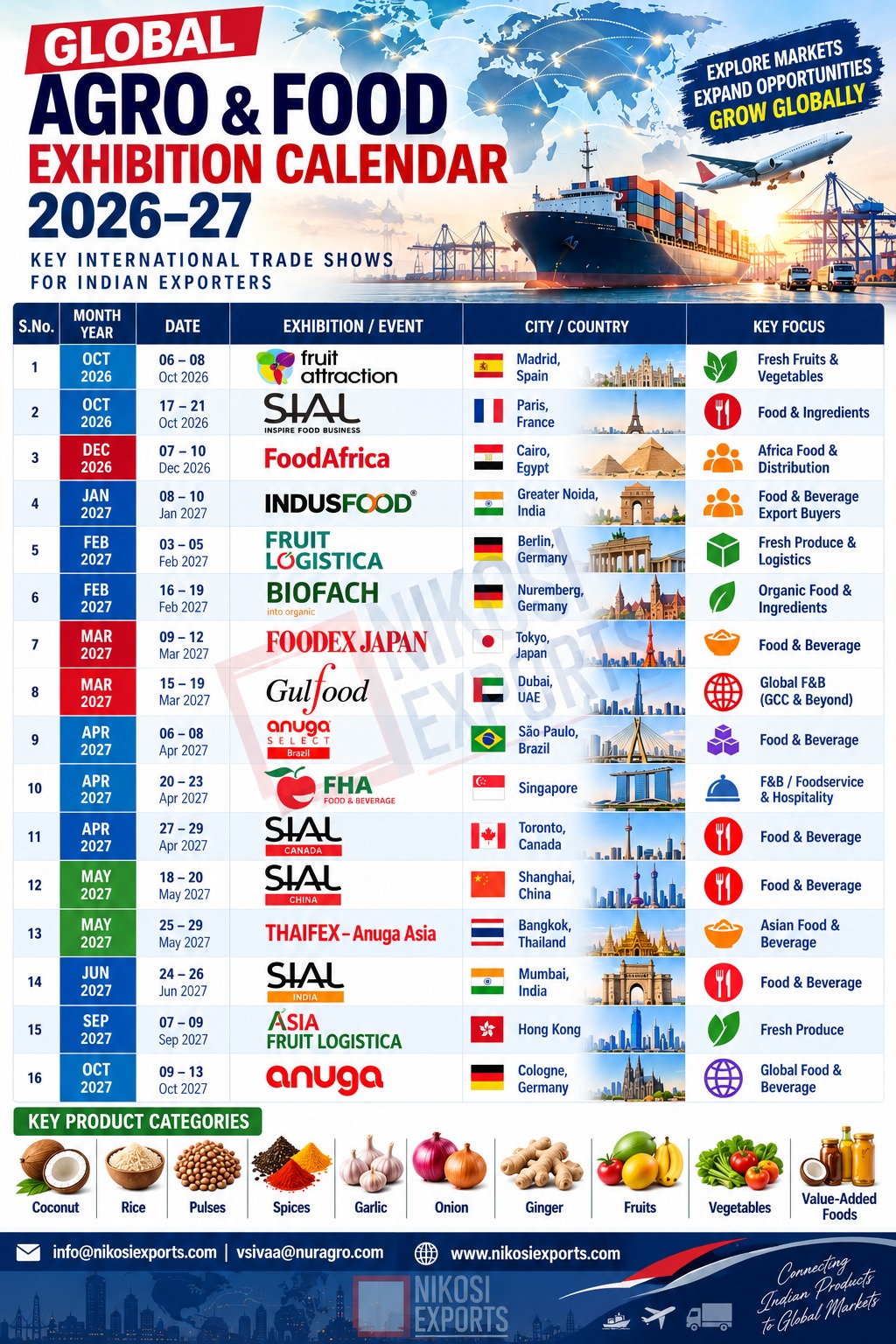
Global Agro & Food Exhibition Calendar 2026–27
Here are some major international exhibitions that Indian Agro & Food Exporters can keep on their planning radar.
October 2026
Fruit Attraction
6–8 October 2026
Madrid, Spain
Fresh fruits and vegetables, produce supply chain, importers, distributors and related businesses.
SIAL Paris
17–21 October 2026
Paris, France
One of the major international food exhibitions, covering food products, ingredients, retail, distribution and food business.
December 2026
Food Africa
7–10 December 2026
Cairo, Egypt
An important event to explore African and regional food markets, distributors and food-industry opportunities.
January 2027
INDUSFOOD
8–10 January 2027
Greater Noida, India
A major platform connecting Indian food businesses with international buyers and sourcing professionals.
For Indian exporters, this can also be an interesting opportunity to meet overseas buyers without immediately travelling outside India.
February 2027
Fruit Logistica
3–5 February 2027
Berlin, Germany
Particularly relevant for fresh fruits, vegetables, produce supply chains, logistics, packaging and related technologies.
BIOFACH
16–19 February 2027
Nuremberg, Germany
An international platform focused on organic food and related products.
For exporters considering this market, certification and destination-market requirements need to be examined carefully before participation.
March 2027
FOODEX JAPAN
9–12 March 2027
Tokyo, Japan
A major food and beverage trade event and an opportunity to understand the Japanese and wider Asian food market.
Japan is a market where product quality, specifications, documentation and compliance can be particularly important.
Gulfood
15–19 March 2027
Dubai, UAE
For many Indian exporters, Dubai remains an important gateway for GCC and wider regional business.
Rice, spices, coconut products, fruits, vegetables, pulses, processed foods and many other food categories can potentially find relevant buyers depending on the event segment and buyer requirements.
April 2027
Fruit Attraction São Paulo
6–8 April 2027
São Paulo, Brazil
An opportunity to explore the Latin American fresh-produce ecosystem.
FHA – Food & Hospitality Asia
20–23 April 2027
Singapore
Food, beverage, hospitality and foodservice opportunities across Singapore and the wider Asian market.
SIAL Canada
27–29 April 2027
Toronto, Canada
A platform for exploring Canadian food and beverage buyers, distributors and related businesses.
May 2027
SIAL Shanghai
18–20 May 2027
Shanghai, China
A major Asian food and beverage platform.
THAIFEX – Anuga Asia
25–29 May 2027
Bangkok, Thailand
An important Asian food and beverage event, particularly for exporters looking at Southeast Asian markets.
June 2027
SIAL India
24–26 June 2027
Mumbai, India
Another opportunity for Indian food businesses to connect with buyers and professionals from India and international markets.
September 2027
Asia Fruit Logistica
7–9 September 2027
Hong Kong
Especially relevant for fresh fruits and vegetables and the wider Asian produce supply chain.
October 2027
Anuga
9–13 October 2027
Cologne, Germany
A major international food and beverage exhibition covering a wide range of food categories and international markets.
But Should Every Exporter Attend All These Exhibitions?
Definitely not.
That is probably one of the most important points we want to share.An exporter does not need to travel to every exhibition.In fact, attending too many exhibitions without a proper plan can consume significant time and money without creating meaningful business.Instead, ask yourself a few simple questions.
What am I exporting?
Which countries do I want to enter?
Who is my buyer?
Is the buyer an importer, distributor, retailer, processor or foodservice company?
Which exhibition attracts those buyers?
Can my company meet their quality and documentation requirements?
What is my budget?
What exactly do I want to achieve from the exhibition?
Once these questions are answered, the exhibition selection becomes much easier.
Don’t Go to an Exhibition Just to Collect Visiting Cards
This is something every new exporter should remember.
Imagine coming back from an international exhibition with:
300 visiting cards.
It may look impressive.
But what happens next?
If nobody knows:
- who needs samples,
- who needs a quotation,
- who is a genuine importer,
- who is a distributor,
- who has an immediate requirement,
- who is only collecting information,
then those 300 cards may simply remain in a drawer or spreadsheet.
Instead, try to come back with:
10 serious conversations
rather than simply:
300 contacts.
Before Going to the Exhibition
The real work should start before the exhibition.
Research the companies attending.
Look at their websites.
Understand their product range.
Find out what countries they source from.
Check whether they are importers, distributors, retailers or manufacturers.
Then approach relevant companies before travelling.
A simple message can be enough:
“We are an Indian exporter of ___ products and will be attending the exhibition. We would be interested in meeting your sourcing team to understand your import requirements.”
Sometimes one properly arranged meeting can be more valuable than spending the entire day walking through exhibition halls.
What Should an Exporter Carry?
A professional exporter should be prepared.
Company profile.
Product catalogue.
Product specifications.
Packaging details.
Certifications.
Laboratory reports where applicable.
Product photographs.
Packhouse or processing photographs.
Available varieties and grades.
Shipment capability.
Basic commercial information.
Samples, wherever permitted and practical.
And most importantly:
A clear answer to the question — “What exactly can you supply?”
Ask Questions Before Giving Prices
An exporter should also learn to listen.
When a buyer approaches, don’t immediately send a price.
First understand:
What product are they buying?
Which origin are they currently sourcing from?
What specification do they require?
What packing do they use?
What quantity do they normally buy?
How frequently do they purchase?
Which port do they receive at?
What certifications do they need?
Are they looking for bulk supply, retail packing or private label?
What is their target market?
These questions help an exporter understand whether there is a genuine commercial opportunity.
And Then Comes the Most Important Part — Follow-Up
The exhibition finishes.
The exporter returns to India.
The photos are posted on LinkedIn.
The visiting cards are kept somewhere.
And then…
Nothing happens.
This is where many opportunities can disappear.
The real work starts after the exhibition.
A buyer may need:
A quotation.
A specification sheet.
A sample.
A certificate.
A revised packing proposal.
A logistics calculation.
A trial shipment.
Or simply another conversation.
That follow-up should be systematic.
Meeting → Requirement → RFQ → Sample → Trial → Feedback → Order → Repeat Business
There is no guarantee that every meeting will become an order.But without proper follow-up, even a good opportunity can easily be lost.How We Would Like to Help Other Indian Exporters
At NIKOSI EXPORTS, we are also exporters.
So we understand that an exporter doesn’t always need another motivational article.Sometimes what is really needed is practical information.
Which exhibition is coming?
Where is it happening?
Who is it meant for?
Which products are relevant?
Which markets can be explored?
What should an exporter prepare?
What should be checked before spending money?
This is one of the reasons we are developing the Guide Area on our website.We want to share useful information that can help other Indian exporters make better-informed decisions around exhibitions and international markets.
What We Can Share Through Our Guide Area
We may share information such as:
Upcoming international exhibitions.
Exhibition dates and locations.
Product categories.
Market opportunities.
Buyer segments.
Exhibition preparation ideas.
Pre-exhibition planning.
Buyer meeting preparation.
Product presentation suggestions.
Export documentation awareness.
Market-entry considerations.
Post-exhibition follow-up methods.
And our own practical observations from the export business.
Our objective is not to say:
“Attend this exhibition and you will get business.”
That would not be responsible.Instead, our objective is:
“Here is the information. Here is what we see. Study it. Compare it with your business. Then make your own decision.”
One More Thing — Let’s Build a Stronger Indian Export Community
India has thousands of exporters.
Some are very large companies.
Some are established SMEs.
Some are first-generation entrepreneurs.
Some are farmers’ organisations and producer groups.
Some are small processing companies trying to make their first international shipment.
Everyone is at a different stage.
We believe there is value in sharing useful information across this ecosystem.
An exporter who has already visited an exhibition can share an experience.
Another exporter may know a market.
Someone else may understand documentation.
Another may have experience with packaging.
Another may know how a particular buyer segment works.
This kind of knowledge sharing can help the wider Indian export ecosystem.
Exhibitions Are Opportunities — Not Guarantees
We would like to make this very clear.
An exhibition cannot guarantee:
A buyer.
An order.
A distributor.
A contract.
Profit.
ROI.
The result depends on the product, price, quality, certification, supply capability, buyer requirement, market conditions, regulations, competition, negotiation and follow-up.
Therefore, before investing in any exhibition, exporters should independently verify the latest information with the official organiser and relevant authorities.
Dates, venues, participation conditions, buyer programmes and costs can change.
Our Simple Thought for Every Indian Exporter
Don’t attend an exhibition just because everyone else is attending.
Go because you have a reason.
Go with a product.
Go with a target market.
Go with a buyer profile.
Go with a meeting plan.
Go with your documents ready.
Go prepared to listen.
And after returning home…
Follow up.
Because the exhibition itself is only the beginning.
The real business is built afterwards.
🇮🇳 From India to the World
India has the products.
India has farmers.
India has processing capability.
India has entrepreneurs.
India has an increasingly connected export ecosystem.
Now we need to connect the right Indian products with the right international markets.
Explore Markets.
Build Connections.
Present Indian Products.
Create Opportunities.
Grow Globally.
Connect With Us
If you are an Indian Agro & Food Exporter and would like to share information, discuss exhibition opportunities or connect regarding international market development, you are welcome to reach us.
NIKOSI EXPORTS
📧 info@nikosiexports.com
📧 vsivaa@nuragro.com
🌐 www.nikosiexports.com
We will continue adding useful Exhibition, Market, Export and Agro-Food Business Guides to help Indian exporters discover opportunities around the world.
Information shared through this Guide Area is intended for general business information and knowledge sharing. Exhibition dates, venues, participation conditions, regulations and market requirements should always be independently verified with the relevant organisers and authorities before making commercial commitments.
